

The idea of reconstructing the museum building arose out of necessity: the museum was originally established in a former late-19th-century stable. Located within the boundaries of Riga’s historical center, the building had previously served utilitarian purposes. The architects faced the task of rethinking the space, its role in the urban environment, and of capturing the mood of the museum—defining its identity as a site of memory in accordance with its time and location.


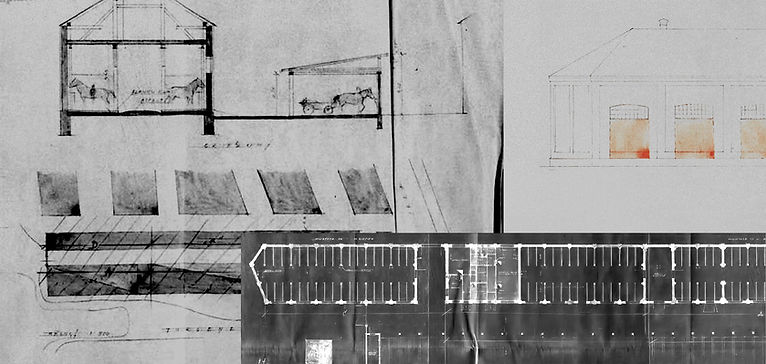

One of the main challenges in working with the building project was its original structure—a very narrow, elongated space divided by a series of columns. The solution was to introduce an internal spatial flow that connects the entire building, from the entrance to the viewing platform overlooking the river.


The museum’s architecture is aimed at creating a minimal yet expressive interaction with its surroundings.
Through openings and visual perspectives, the building enters into a dialogue with the city.
The museum does not confine itself within its walls; it engages with the city, blurring the boundaries between inside and outside, and creating unexpected visual connections.


To accommodate the museum’s functions, it was decided to expand the building by raising the roof and adding a new floor.
The use of similar materials with varied textures emphasizes the dialogue between old and new: the upper part of the façade differs in rhythm and texture from the lower part, creating a visual “break” and highlighting the new volume above the existing structure. This break serves as a visual symbol of change and transition.


During the design process, three central concepts were identified: distance, memory, and time.
The multi-level organization of the space evokes the layers of time.
The space is arranged in such a way that visitors are constantly aware of their connection to others in the museum. This is achieved through open areas where people on different levels remain visible to one another.


The museum space is conceived as a “journey” organized around a diagonal axis.
It unfolds as a spatial ceremony, where a person, moving through it, experiences a “turn” — a transition from fate (what is predetermined) to purpose (what is chosen).


